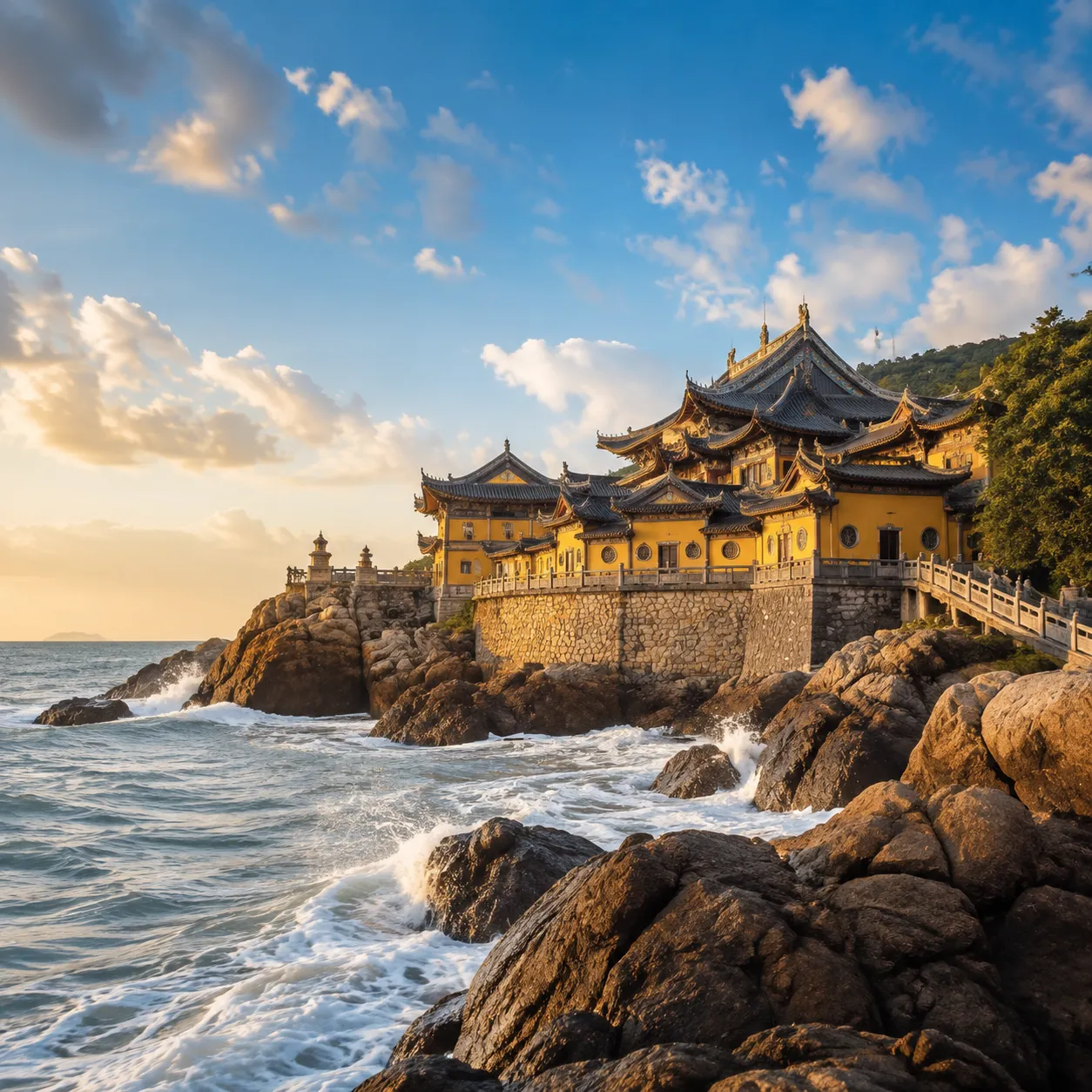
Photo: Chinese Mountains
Mount Putuo
Pu Tuo Shan
Sacred Buddhist island mountain where the sea meets the dharma
About Mount Putuo
Mount Putuo (Putuoshan) is unique among China's sacred mountains — it is an island. Located in the East China Sea off the coast of Zhejiang Province near Ningbo, this 12.5-square-kilometer island is dedicated to Bodhisattva Avalokitesvara (Guanyin), the goddess of mercy and one of the most beloved figures in East Asian Buddhism. For over 1,000 years, sailors, fishermen, and pilgrims have crossed the sea to Putuo seeking Guanyin's protection and blessing. The island's landscape is gentle and lush — forested hills rise to 291 meters at Foding Peak, sandy beaches line the eastern shore, and the sound of waves mingles with temple bells and chanting. Three major temples anchor the pilgrimage circuit: Puji Temple (the largest, with a 1,000-year-old camphor tree in its courtyard), Fayu Temple (built into a hillside with waterfalls cascading through its grounds), and Huiji Temple at the summit. A 33-meter golden statue of Guanyin stands on the southern shore, visible to approaching ferries, one hand raised in blessing. Beyond the temples, Putuo offers excellent coastal hiking — the 5-kilometer path between Puji and Fayu temples follows the shoreline with views of rocky headlands and distant islands. The island prohibits private cars, creating a peaceful atmosphere rare in Chinese tourist destinations. Putuo is reachable by ferry from Ningbo (2 hours) or Shanghai (4 hours by car to the ferry terminal plus 50-minute fast ferry). Spring (March-May) and autumn (October-November) offer the most pleasant weather. Accommodation ranges from basic pilgrim guesthouses at temples to resort hotels. Note that as a Buddhist sacred site, most restaurants on the island serve vegetarian cuisine.
Mountain Facts
Cultural Significance
Sacred to Guanyin (Avalokitesvara), the Bodhisattva of Compassion. One of China's four sacred Buddhist mountains, uniquely set on an island.
Highlights
- • Puji Temple
- • Guanyin of the South Sea statue
- • Fayu Temple
- • Thousand Step Beach
- • Chaoyin Cave
When to Go
April-June offers the best balance: 15-25 C, blooming camellias and azaleas, and the island's famous sea mist creating atmospheric temple views. September-November is the second peak window with crisp air and the clearest views of the 33m Guanyin statue. July-August is peak season: hot (28-33 C), humid, and crowded, but this is also when the island's beaches (Hundred Step Beach, Thousand Step Beach) are swimmable. Winter (December-February) is mild (5-15 C) and quiet, with fewer ferries; the Guanyin birthday festival (19th day of the 2nd lunar month, around March) brings tens of thousands of pilgrims and is the most significant event of the year. Typhoons (July-September) occasionally close the ferries for 1-3 days — check weather before traveling.
How to Get There
By Air: Fly to Ningbo Lishe International Airport (NGB) or Zhoushan Putuoshan Airport (HSN, smaller, flights from Beijing/Shanghai/Guangzhou/Fuzhou). From Ningbo, take the high-speed train to Ningbo South or the direct ferry from the Ningbo Baifeng Ferry Terminal to Putuo (about 2-2.5 hours by boat). By Ferry: The most common route is from Shenjiamen (Zhoushan Island) — ferries run frequently (20-30 min, CNY 30-40). From Shanghai, the Wusongkou ferry to Putuo takes about 12 hours overnight; a fast ferry from Shanghai South (Xiaoyangshan) takes 4 hours. By High-Speed Train: Ningbo station connects to Shanghai (2h) and Hangzhou (1h); from Ningbo, take a bus to Shenjiamen (1.5h) then the ferry. Entry Fee: CNY 160 (Nov-Mar) / CNY 200 (Apr-Oct). Island shuttle buses (CNY 5-10 per ride) connect the temples and beaches.
Frequently Asked Questions
Is Mount Putuo worth visiting? +
What is the best time to visit Mount Putuo? +
How do I get to Mount Putuo? +
How difficult is visiting Mount Putuo? +
What should I bring for Mount Putuo? +
You May Also Like
Mount Huangshan
Huang Shan · Anhui
China's most iconic peaks — sea of clouds and granite spires
Mount Sanqing
Sanqing Shan · Jiangxi
A quieter Huangshan — granite peaks without the crowds
Mount Lushan
Lu Shan · Jiangxi
The mountain of poets, mist, and colonial villas — 1,500 years of inspiration